
Understand first
Education-first • not medical adviceOpen the deep dive
What’s going on
Indoor air quality is shaped by particles (dust, pollen, smoke), moisture (damp/mould risk), and gases (cooking fumes, fragranced products). The aim is to reduce exposure in the rooms you actually use.
Why it matters
Poor air can worsen comfort and may aggravate allergies or asthma in sensitive households. The practical goal is to identify the pollutant or moisture problem first, then use source control, ventilation or filtration appropriately.
Common causes
- Poor ventilation, especially during colder weather.
- Cooking fumes without effective extraction.
- Damp rooms, slow-drying laundry and unresolved moisture sources.
- Smoke, pollen, dust and fragranced products adding particles or irritants.
No-spend first steps
- Use extraction during cooking and showering and ventilate strategically.
- Measure humidity when damp or condensation is part of the problem.
- Reduce pollutants at source where practical.
- Dust and vacuum regularly in the rooms that matter most.
If you’re buying anything, use this calm checklist
- For particles, match purifier airflow and filtration to the actual room.
- For excess moisture, address leaks and ventilation before considering dehumidification.
- Check noise, electricity and replacement-filter costs before buying.
General information only. If you have symptoms or a medical condition, consult a qualified clinician.
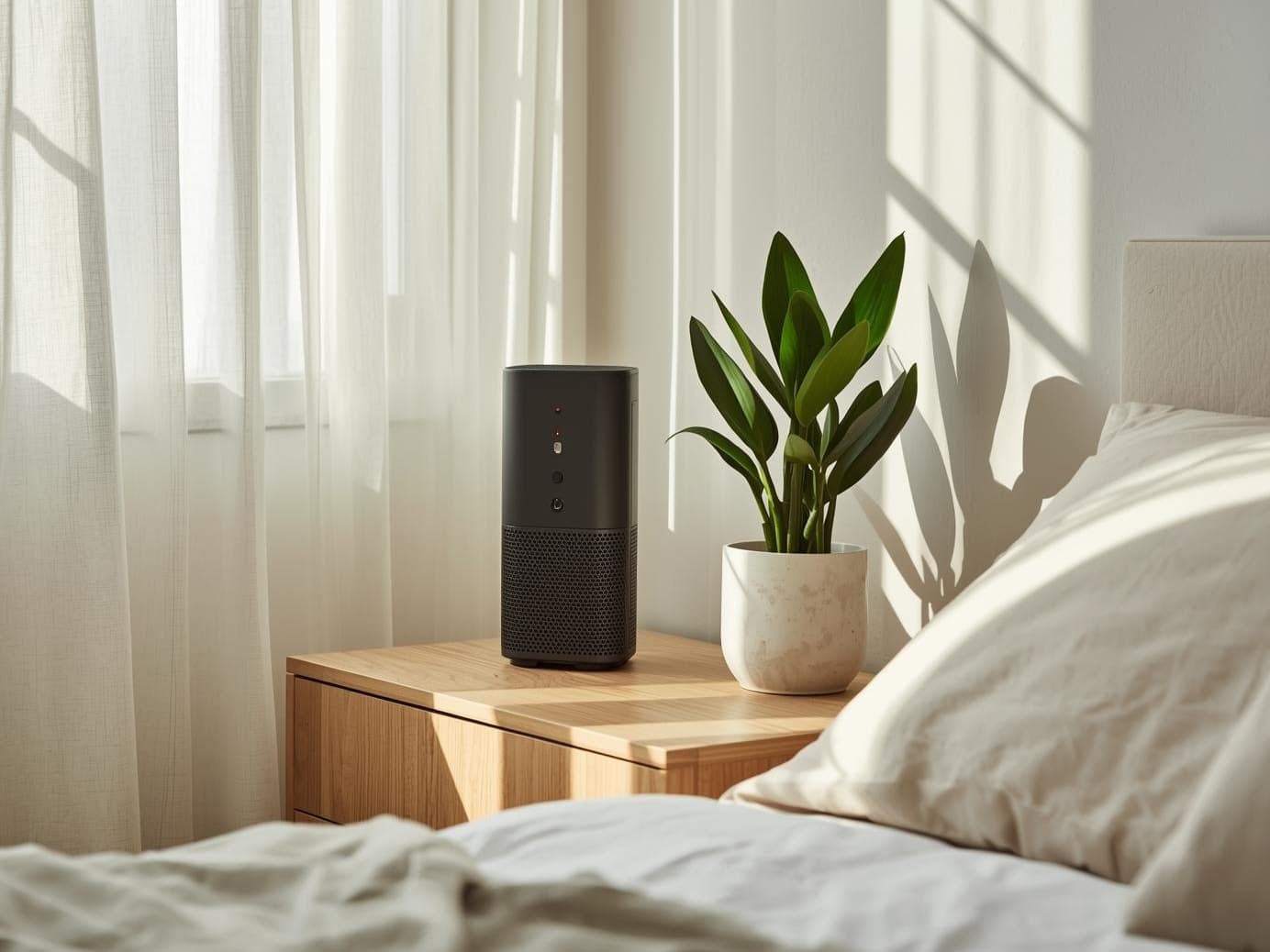
A small room does not automatically need the smallest or cheapest air purifier. The useful question is whether a unit can move enough air for your room, at a fan speed quiet enough that you will actually run it, with replacement filters you are willing to keep buying.
Fast routes: Small-flat purifier guide → • Allergy purifier guide → • Current Air Quality shortlist →
Start with the problem, not the purifier
Air purifiers are mainly particle-control tools. They can be useful for things such as pollen, airborne dust and fine particles when correctly sized and run consistently.
They are not the first answer to every air-quality problem:
- Condensation or damp: measure humidity and address moisture first. A purifier does not remove water from the air.
- Cooking fumes: use source control and effective extraction first.
- Stale rooms: ventilation matters; a purifier does not replace fresh-air exchange.
- Recurring mould: find and address the moisture source rather than relying on filtration alone.
If damp or condensation is your actual problem, start with our winter humidity guide → or dehumidifier guide →.
1. Measure the room you will actually treat
Do not size a purifier using the total floor area of your home if it will spend most of its time in one bedroom or office.
Work out the approximate room dimensions and compare them with the manufacturer's current room-coverage or clean-air-delivery information. Be cautious with very large advertised coverage figures if they assume only a low number of air changes per hour.
For a small room, a slightly more capable unit running at a lower practical speed can sometimes be more comfortable than an undersized unit that needs to run loudly.
2. Compare noise at a useful fan speed
The lowest published noise figure usually describes the quietest setting. That number is useful, but it does not tell you how loud the purifier will be at the speed needed to clean the room effectively.
For bedroom use, check:
- sleep-mode noise;
- whether display lights can be dimmed or switched off;
- whether automatic mode behaves sensibly overnight;
- noise at medium or normal operating speed, not only minimum speed.
If noise makes you switch the purifier off, its theoretical specification stops mattering.
3. Treat replacement filters as part of the purchase price
Before buying the machine, find the exact replacement filter and answer three questions:
- Can you reliably buy it in the UK?
- What does one replacement currently cost?
- How often does the manufacturer say it normally needs changing?
A cheaper purifier can become the more expensive choice if proprietary filters are costly or difficult to source.
Use our filter replacement-cost guide → before committing.
4. Think about placement
A purifier needs space to move air. Do not bury it behind furniture or push the intake tightly against a wall unless the manufacturer specifically designs it for that placement.
In a bedroom, a practical position is usually somewhere with unobstructed airflow that does not create an annoying draft or noise directly beside your head. In a home office, keep the intake and outlet clear rather than hiding the unit under a desk.
5. Decide whether carbon filtration matters
Particle filtration and odour/gas reduction are different jobs. If cooking odours or some gaseous pollutants are part of the reason you are buying, check whether the unit includes a meaningful activated-carbon stage rather than assuming every purifier handles odours equally well.
For cooking, candles or indoor smoke events, source control still comes first. Our healthy air at home guide → explains the order of operations.
Quick decision guide
| Your main situation | Start here | What to prioritise |
|---|---|---|
| Small bedroom or office | Small-flat purifier guide → | Room sizing, useful-speed noise, filter cost |
| Pollen, dust or allergy focus | Allergy purifier guide → | Particle filtration, room coverage, consistent use |
| Damp or condensation | Dehumidifier guide → | Humidity measurement and moisture control |
| You already know you want a purifier | Air Quality shortlist → | Compare maintained partner options |
Before you buy
Use this final check:
- I know which room the purifier is for.
- I have checked realistic room coverage.
- I have checked noise beyond the minimum setting.
- I know the price and availability of replacement filters.
- I am not using a purifier to solve a humidity or ventilation problem.
If those answers are clear, move to the small-flat purifier buying guide → or compare the current Air Quality shortlist →.
Make the next decision easier
Occasional Wild & Well notes with practical actions, useful comparisons and no-pressure product guidance.
By subscribing you agree to our privacy policy. Unsubscribe anytime.
Related reading
Keep learning — then choose the simplest next step.
 Insight
Damp & Mould in UK Rentals: the practical playbook
A practical renter checklist for damp and mould: measure humidity, reduce moisture, improve ventilation, document the pattern, then compare dehumidifiers only when humidity control is the right tool.
 Explainer
Filter replacement costs: the simple way to estimate your yearly spend (UK)
A practical UK guide to the real ownership cost of air, water and shower filters — with a simple yearly-cost formula and direct routes to maintained shortlists.
 Explainer
Healthy Air at Home: A Practical UK Guide
A practical UK home-air guide: reduce pollution at source, control moisture, improve ventilation and only then compare purifiers or dehumidifiers when they solve the right problem.
ExplainerWinter Humidity Guide (UK): Dry Air, Condensation or Damp?
A practical UK winter humidity guide: measure first, separate dry-air problems from condensation and damp, then choose ventilation, humidification or dehumidification appropriately.
 Explainer
Water Filter Buying Guide (UK): choose the right type first
A practical UK guide to choosing between jug, countertop, under-sink, RO, gravity and portable water filters — with replacement cost and maintenance checks before you buy.
 Explainer
Hard water in the UK: what it affects (and what it doesn’t)
A calm, UK-specific guide to hard water: what to expect, common myths, and how to decide between no-spend comfort changes, shower filtration, drinking-water filtration and softening.
Related shortlists
If you’re comparing products, these are built to be quick: what matters, what to avoid, and a short shortlist.
Air quality partner shortlist (UK)
Direct partner links for air purifiers, dehumidifiers, filters and airflow options.
In: Home essentials
Air purifiers for allergies (UK)
Shortlist for common UK rooms with clear size guidance and trade‑offs.
In: Home essentials
Air purifiers for small flats (UK)
Compact options that make sense in smaller rooms.
In: Home essentials
High‑protein meal prep (UK)
Meal prep as a bridge on busy weeks: reduce decision fatigue, keep it food-first.
In: Nutrition staples (UK)
Ethical meat delivery (UK)
A guide to higher‑welfare meat delivery: what to look for and how to plan freezer space.
In: Nutrition staples (UK)
Extra virgin olive oil (UK)
A shortlist focused on freshness and sensible buying.
In: Nutrition staples (UK)